
Question 1
Figure shows Rejaan’s room with points OABC marking its corners. The x- and y-axes are marked in the figure. Point O is the origin.
Figure: Rejaan’s Room
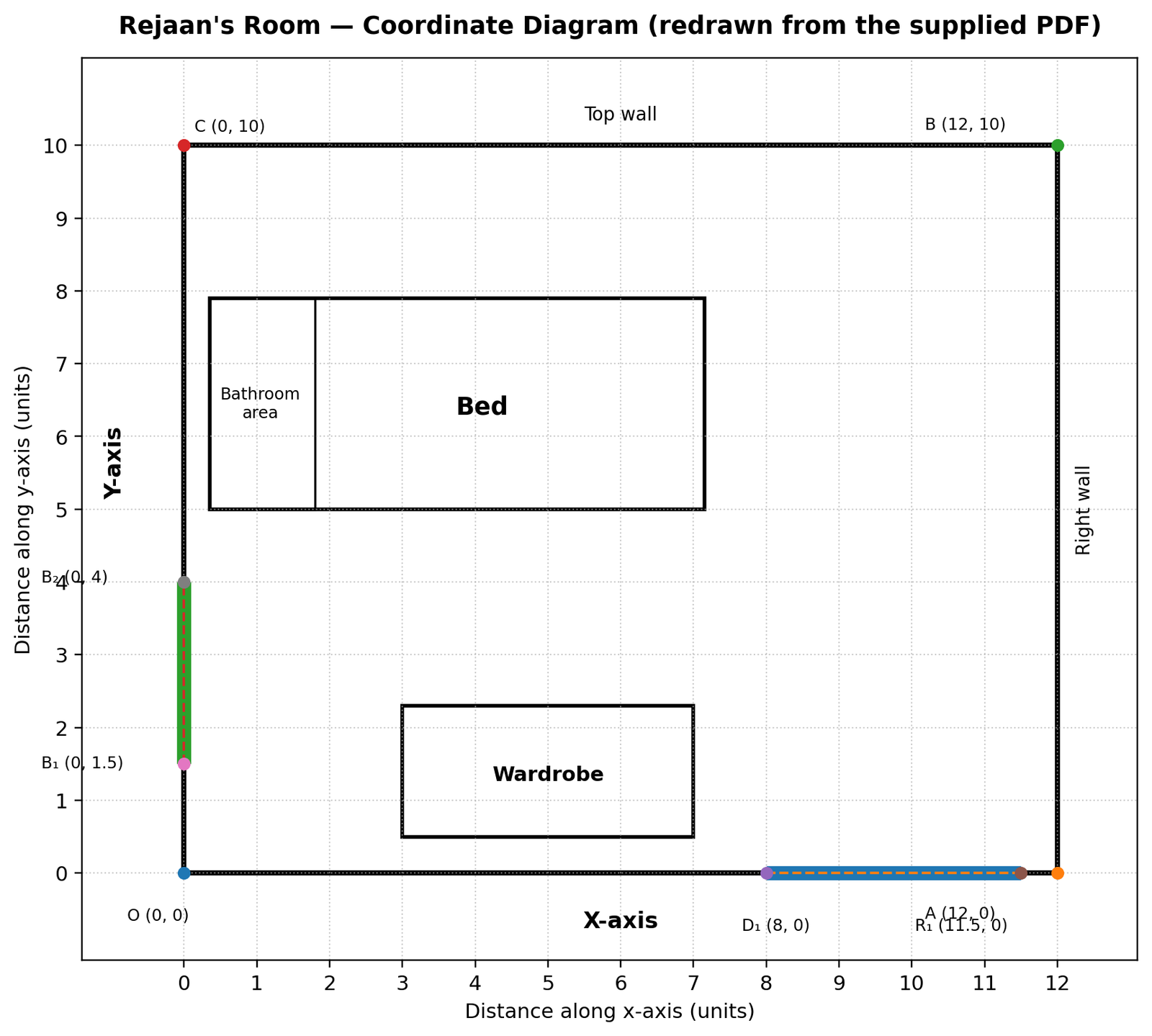
The room boundary has corners O(0, 0), A(12, 0), B(12, 10) and C(0, 10). The room door is represented by D₁R₁ on the x-axis, and the bathroom door by B₁B₂ on the y-axis.
(i) Door’s distance from the left wall and from the x-axis
Question: If D₁R₁ represents the door to Rejaan’s room, how far is the door from the left wall (the y-axis) of the room? How far is the door from the x-axis?
Solution:
The door begins at point D₁, which lies on the x-axis 8 units to the right of the origin. The left wall is the y-axis (x = 0). Therefore, the door is 8 units away from the left wall.
The entire door D₁R₁ lies on the x-axis itself. Hence, its distance from the x-axis is 0 units.
Answer: 8 units from the left wall and 0 units from the x-axis.
(ii) Coordinates of D₁
Question: What are the coordinates of D₁?
Solution:
Point D₁ lies on the x-axis, so its y-coordinate is 0. It is 8 units to the right of the origin, so its x-coordinate is 8. Therefore, the coordinates are D₁ = (8, 0).
Answer: D₁ = (8, 0).
(iii) Width of the room door and wheelchair access
Question: If R₁ is the point (11.5, 0), how wide is the door? Do you think this is a comfortable width for the room door? If a person in a wheelchair wants to enter the room, will he/she be able to do so easily?
Solution:
The width of the door is the difference between the x-coordinates of R₁ and D₁.
Width = 11.5 − 8 = 3.5 units
Taking 1 unit = 1 foot, the door is 3.5 feet wide. The supplied solution notes that standard room doors are usually 2 to 3 feet wide, so a 3.5-foot door is more than comfortable. It also notes that a typical wheelchair measures about 2 to 2.25 feet across. Since this is less than 3.5 feet, a person using a wheelchair can enter the room without difficulty.
Answer: The door is 3.5 units (3.5 feet) wide; it is comfortable and wide enough for wheelchair access.
(iv) Comparing the bathroom door with the room door
Question: If B₁ (0, 1.5) and B₂ (0, 4) represent the ends of the bathroom door, is the bathroom door narrower or wider than the room door?
Solution:
Both B₁ and B₂ lie on the y-axis. Therefore, the width of the bathroom door is the difference between their y-coordinates:
Bathroom door width = 4 − 1.5 = 2.5 units
The room door is 3.5 units wide, while the bathroom door is 2.5 units wide. Since 2.5 is less than 3.5, the bathroom door is narrower than the room door.
Answer: The bathroom door is 2.5 units wide and is narrower than the 3.5-unit room door.
Quick Answer Summary
| Sub-question | Key result | Answer |
| (i) | Distance from left wall / x-axis | 8 units / 0 units |
| (ii) | Coordinates of D₁ | (8, 0) |
| (iii) | Room door width | 3.5 units (3.5 feet) |
| (iv) | Bathroom door width and comparison | 2.5 units; narrower |
Source note: The uploaded PDF contains the introductory figure and the four parts (i)–(iv) of Exercise 1.1 on pages 2–3. Page 3 then starts Exercise 1.2; that material is not included here.